

Jason Hickel and his co-author Dylan Sullivan make a dramatic claim: the “Great Convergence” is a myth, the core-periphery income gap has widened by 170-270% since 1960, and neoliberal globalization made the periphery poorer, not richer. But much like his last piece, it’s built on a series of choices and assumptions that make his point necessarily true, but misleading.
At the beginning, they suggest using market exchange rate (MER)-adjusted incomes as the “real” measure of inequality, on the theory that MER better reflects “command over world-market resources.” This is instead of the more common measure of purchasing power parity (PPP), which is more commonly used as a welfare-relevant adjustment because it tells you if someone in Vietnam or Ghana can buy more rice, healthcare, and housing than before and relative to other countries. MER inequality tells you mostly about exchange-rate volatility that is less relevant for development and well-being. This inflates the inequality numbers they find; but to be fair, their broader story still “looks like” it holds without this adjustment, so I’ll focus on other, more substantive issues.
The paper’s other headline number, the absolute income gap growing 170-270%, is more of a mathematical artifact than a real point about convergence/divergence. As my co-author in a Hickel-response piece, Christian Lessmann, points out:
The paper’s absolute Gini is the Gini multiplied by mean income. It is scale-dependent: if all incomes double, the relative distribution is unchanged, but the absolute Gini doubles. Much of its long-run rise may simply reflect global income growth. Example: North has GDP per capita of $40k, South $10k. The Gini is 0.30 and the absolute Gini $7.5k. If both economies double to $80k and $20k, nothing about relative inequality changes—the Gini remains 0.30—but the absolute Gini doubles to $15k.
Global GDP per capita has grown roughly 3-4x in real terms since 1960. So the substantial share of the “170-270% widening” gap the paper reports about could be nothing more than this scaling effect. This measure could simply be telling us that the world got richer, but the framing of the paper is that the poor were left behind.
In fact, the evidence we do have so far tells us that economic growth helps the poor. Vincent Geloso makes this point for the Montreal Economic Institute, and uses some data from a previous paper of mine to help illustrate this point.
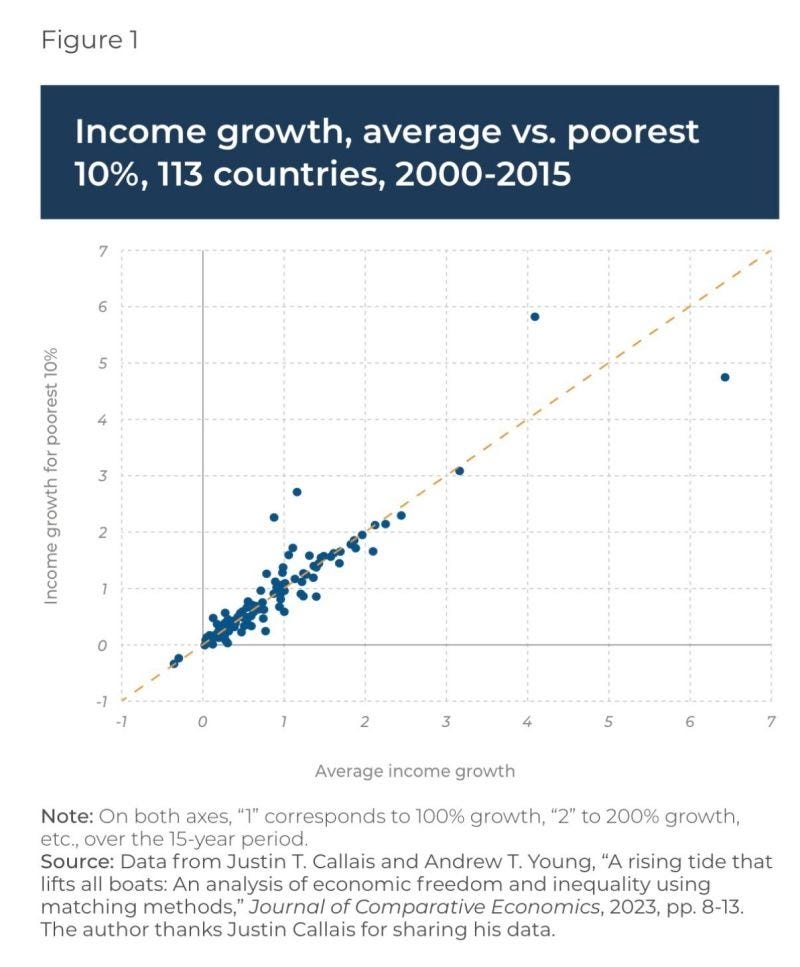
What this figure shows is that when a country’s economy grows, so do the incomes of the bottom 10%, and most of it happens at close to the same rate. So we see at least within countries, that when the countries get richer, the poor are not left behind. But Hickel and Sullivan’s story is that liberalizations have failed to reach ordinary people even when world income rises; but the empirical relationship is just not there.
Not Learning Lessons
Hickel makes the same mistakes that were made in his last piece, one that we responded to on Substack and in a working paper.
Perhaps the biggest hold in this story is the argument that neoliberal globalization and market liberalization caused the divergence of the 1980s-90s; however, the “periphery” aggregate lumps together countries that liberalized aggressively, countries that liberalized on paper but not in practice, and countries that stayed heavily protectionist and state-directed throughout the period. They got lumped together even though the paths and policies were quite different. The paper leans hard on the claim that IMF/World Bank structural adjustment programs led to the divergence. Like his last paper, they do not separate which countries got adjustment programs, why they received them in the first place (usually because they had poor economic performance), or any counterfactual assessment of what the country’s situation would look like without the programs. And most notably, assuming that SAPs are equal to liberalizations, which is not true and has been debunked long before his paper came out.
Furthermore, the composition of the groups makes the outcome almost pre-ordained. The paper pulls South Korea, Taiwan, Singapore, and Hong Kong, the “periphery’s” most dramatic liberalization success stories, out of the “periphery” bucket entirely and reclassifies them as “new core” once their incomes rose high enough. But those are exactly the cases of countries that do free up markets and become rich; so taking them out equates to removing the cases that don’t suit your story nicely. So the countries that liberalized and succeeded get redefined away, while the countries that stayed protectionist and stagnated stay in, which all but guarantees their point to be true.
Once again, the work by degrowthers leaves a lot to be desired by using faulty data, funny tricks, and ignoring the vast literature on their points without directly disputing it.
Sounds like they got the answer they were looking for.