
Markets are Egalitarian Forces

In a lot of my work, I focus on how economic freedom and market-based institutions are not just good on average but across society, and notably, help people move along the income ladder. The framing of “markets are egalitarian forces” didn’t stick with me until recent conversations with my friend Vincent Geloso, who I recently sat down with for a podcast interview. We talked about his new book The Great Enrichment: A New History of American Growth and Inequality, 1865-1945. He specifically calls this era the first egalitarian enrichment period in the U.S.

Vincent’s makes a point that sounds “bad” but is really key: markets are impersonal. That impersonality can be treated as a flaw, that markets are cold and uncaring, or indifferent to your circumstances. But if you think about it another way, that impersonality is exactly what can make markets egalitarian. In the market, people don’t care if you were born poor; they don’t care about who your father is. It instead cares about the value you create.
Under different institutions, people may care about these things, and that caring would burden the poor more than the already well-off. If we sorted ideas and employment based on your status, then the poor would only further be restricted from the chance at mobility and prosperity. Status and birthright would carry the day, instead of the value you can provide. In market societies, people can freely enter an industry and get matched based on where their value is the highest.
Innovation and Prosperity
I’ve cited this a few times, but it’s worth coming back to here. Economist William Nordhaus estimated that less than 3 percent of the gains from innovation go to the innovator/founder, and the rest is spillovers to the broader economy through higher wages, complementary services, and better access to goods and services. This means innovation is redistributive on its own, and this is before what we normally consider redistribution (taxes and transfers).
In the same vein, this era of the U.S. saw deflation (lower prices) for the poor and inflation (higher prices) for the rich, which is again redistributive. During the end of the 1800s, the industries that saw the fastest innovation were much more likely to be those that were producing goods that poorer households bought (namely, food). Those prices decreased in real terms. On the flip side, what rich households spent their money on went up, namely labor-intensive services like servants. The cost of employing a worker for the home rose, so it was less feasible. This is why today, for example, people are notably richer than before, but fewer people have live-in maids and home assistance than before, when it was quite common to see in rich households. Since wages rose for the poor, it made employing people to perform those tasks more costly. Combine these two forces together and you get the cost of living falling for the poor and rising for the rich from the same process of innovation.
This is True Today Too
Vincent’s book is about the late 1800s and early 1900s, so an obvious follow-up is: does this still hold true today? Well, in a paper that Vincent and I wrote (along with Gary Wagner and Alicia Plemmons), we find history repeating itself. Using Raj Chetty and his team’s intergenerational mobility and social capital data for U.S. metro areas, we find that kids who grew up in high economic freedom areas experience 5 to 12 percent more upward mobility than kids in low-freedom areas. And importantly, it’s not through some indirect mechanism like reducing income inequality; it’s more direct. (In fact, there’s little evidence that economic freedom matters for inequality). Free markets raise mobility by opening more pathways for opportunity; more competition, more chances at innovation, more labor market possibilities.
What Does This Mean for Today?
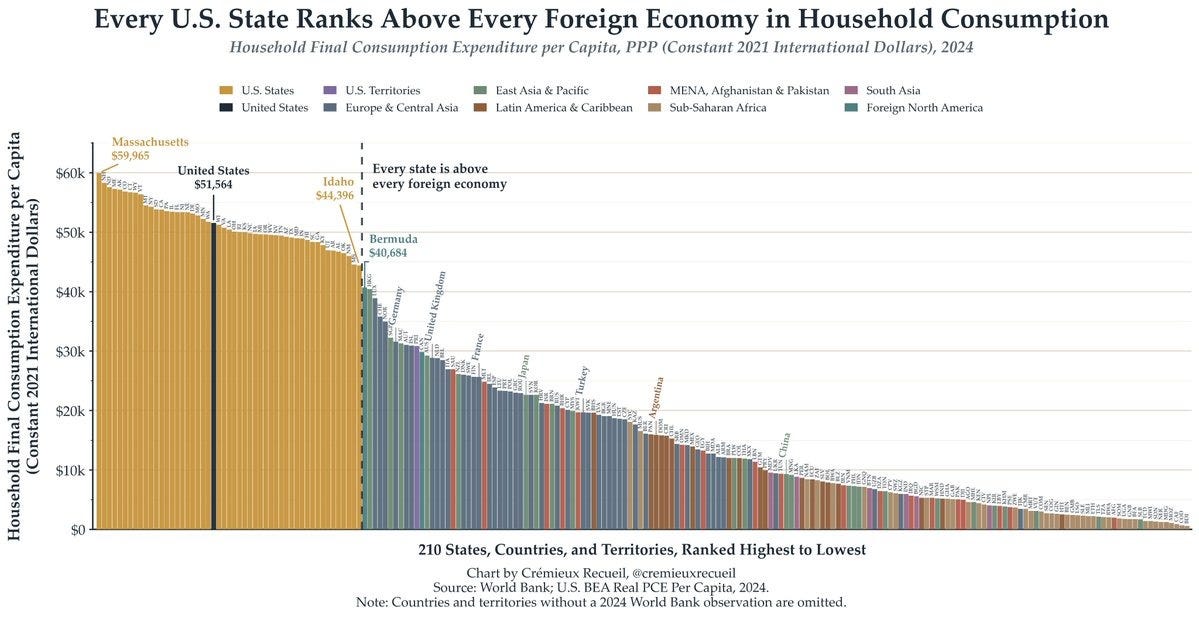
These ideas and principles matter for policy and opportunity today. Something worth noting before jumping to today: the average income of the bottom 90% of Americans during that period of history was higher than the average incomes of almost every other country on earth! And even today, average household consumption in every U.S. state (even the poorest) is higher than every foreign country, showing the mass amount of well-being that we have here in the states.
Back to today. Vincent ends the book and our podcast conversation on redistribution and intervention. Redistribution (the kind we normally think of, social safety net programs) is a genuine contestable policy question; people disagree on design and scope. But intervention (occupational licensing, zoning restrictions on housing and developments, tariffs, protected monopolies, business regulation, and most labor restrictions) is less contestable in terms of providing opportunity. There’s no real serious case that licensing helps the poor and that onerous zoning restrictions don’t make housing more expensive. Deintervention is a powerful force towards providing real mobility for people, especially those at the bottom of the income ladder. That’s the throughline in our entire conversation. Markets do not need permission or nudges to be egalitarian; they mainly just need the opportunity to provide opportunity.
I sympathize and, mostly, agree with Vincent and you. Yet, the notion of social mobility is challenging; I am still digesting Clark’s The Son Also Rises.